

What if your business could advertise to potential customers while they are comparing products or services at a competitor’s location?
That’s the idea behind competitor geofencing, also known as geoconquesting.
Instead of relying entirely on broad geographic targeting or hoping customers discover your business through search engines, geoconquesting helps advertisers reach eligible audiences associated with relevant competitor locations.
For automotive dealerships, retail stores, restaurants, home service providers, and other businesses, this strategy can create opportunities to reach consumers during important stages of their purchasing journey.
But how does competitor geofencing actually work? Can you legally target competing businesses? How much does geoconquesting cost? And what makes a campaign successful?
In this guide, we’ll explain the technology, strategies, costs, privacy considerations, and best practices behind effective competitor geofencing advertising.
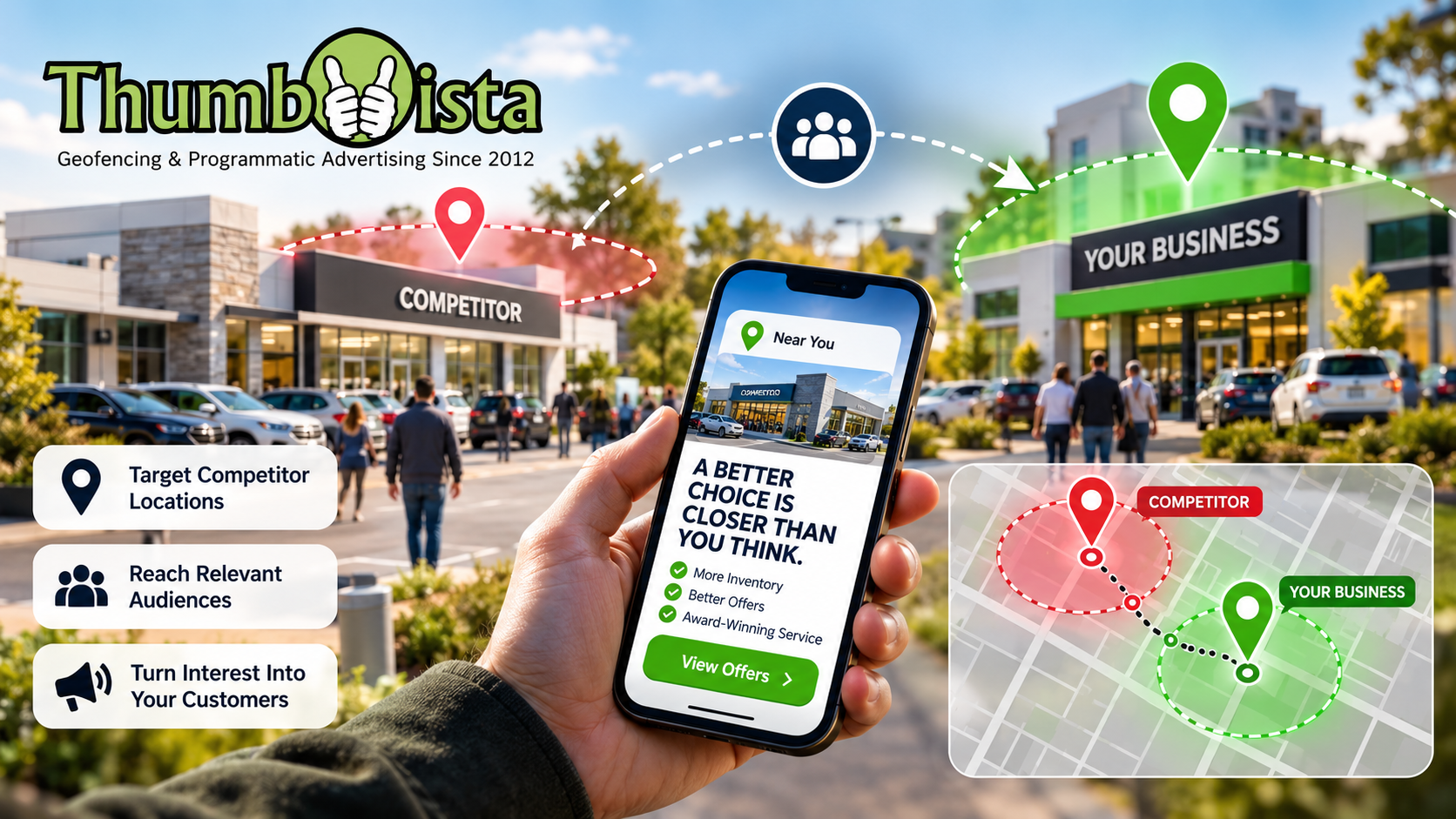
What Is Competitor Geofencing?
Competitor geofencing is a location-based digital advertising strategy that uses geographic boundaries around competing businesses to help advertisers reach relevant audiences through programmatic advertising.
These boundaries, called geofences, can be created around physical locations such as:
- Competing automotive dealerships.See Case Study
- Retail stores and shopping centers.
- Restaurants and quick-service dining locations.
- Home improvement stores.
- Fitness centers and gyms.
- Hotels and hospitality properties.
- Other commercially relevant locations where targeting is permitted.
Depending on the advertising platform, available location signals, audience eligibility, and privacy requirements, advertisers may reach people who are currently in a targeted area or eligible audiences associated with prior visits.
Not every device or visitor can be identified or reached, and location targeting is not perfectly precise.
What Is Geoconquesting?
Geoconquesting is a competitive advertising strategy designed to attract customers who are considering or visiting competing businesses.
Geoconquesting often uses geofencing technology, but the two terms are not exactly the same.
Geofencing describes the technology or geographic targeting method. Geoconquesting describes the marketing objective: winning attention and potential business from competitors.
For example, a car dealership might use geofencing to reach eligible consumers associated with competing dealership locations.
The dealership could promote a relevant vehicle offer, financing promotion, trade-in evaluation, or product comparison.
The objective is to encourage shoppers to consider an alternative before making a final purchasing decision.
How Does Competitor Geofencing Work?
A typical competitor geofencing campaign involves several stages.
1. Identify Competitor Locations
The advertiser starts by identifying businesses that compete for the same customers.
These may include direct competitors, businesses offering substitute products, or locations associated with relevant purchasing interests.
For example, an automotive dealership could identify competing dealerships selling similar vehicle categories within its market.
2. Create Geographic Boundaries
Geographic targeting areas are established around the selected locations.
Depending on the platform, these may use polygon-based geofences, radius targeting, or other geographic targeting methods.
Polygon targeting can help advertisers define more specific geographic areas, although actual location accuracy depends on the underlying data and technology.
3. Develop the Target Audience
Advertising platforms evaluate eligible location signals and available audience data according to their capabilities and privacy requirements.
Additional targeting criteria may include geographic market, contextual interests, demographic attributes where permitted, and other available audience segments.
These criteria help advertisers focus on relevant prospects rather than relying solely on physical proximity.
4. Deliver Programmatic Advertisements
Eligible audiences may be reached through advertising placements across supported websites, mobile applications, and other digital environments.
Campaigns can feature promotional offers, product comparisons, brand messaging, or invitations to learn more.
Advertising delivery depends on inventory availability, platform policies, targeting eligibility, and campaign settings.
5. Measure and Optimize Performance
Advertisers evaluate campaign performance using metrics such as impressions, clicks, website engagement, conversions, and eligible attribution reporting.
Where supported, foot-traffic attribution may help assess whether exposed audiences subsequently visited an advertiser’s location.
These measurements should be interpreted carefully because attributed activity does not necessarily prove that advertising caused a visit or purchase.
Example: Competitor Geofencing for Automotive Dealerships
Automotive dealerships are a common example of how geoconquesting can support local advertising.
Consider a dealership that wants to attract customers shopping for midsize SUVs.
Rather than targeting every adult in the surrounding metropolitan area, the dealership could identify competing locations where consumers are likely to compare similar vehicles.
A campaign might include:
- Geographic targeting around relevant competitor dealerships.
- Mobile and programmatic display advertisements.
- Creative highlighting vehicle inventory or current offers.
- Landing pages featuring available models and appointment requests.
- Website retargeting for eligible visitors.
- Conversion tracking for lead submissions and other measurable actions.
This approach allows the dealership to combine local market relevance with messaging designed for active vehicle shoppers.
Actual results depend on audience availability, campaign budget, creative quality, competition, and the dealership’s offer.
Which Industries Benefit From Competitor Geofencing?
Geoconquesting can be useful in industries where customers frequently compare nearby businesses before making a decision.
Automotive Dealerships
Dealerships can target relevant geographic areas around competing dealerships and promote inventory, trade-in opportunities, financing offers, or dealership advantages.
Retail Stores
Retail advertisers can build campaigns around competing stores or shopping areas to promote seasonal sales, product selection, store locations, and special offers.
Restaurants and Quick-Service Dining
Restaurants may use location-based advertising around competing dining locations to promote menu items, limited-time offers, loyalty programs, or convenient nearby alternatives.
Home Services
HVAC, roofing, plumbing, and other home service companies can use geographic and audience targeting strategies to reach relevant local markets. Competitor-location targeting may be less direct in these categories because customers do not always visit a competitor’s physical location before purchasing.
Fitness Centers
Gyms and fitness studios can promote memberships, introductory offers, classes, or facility benefits to eligible audiences associated with competing fitness locations.
Hotels and Hospitality
Hospitality businesses may use geographic advertising around relevant commercial areas and competing properties, subject to applicable targeting restrictions.
Campaigns should focus on legitimate marketing relevance rather than identifying individual guests or visitors.
Competitor Geofencing vs. Traditional Geographic Targeting
| Feature | Traditional Geographic Targeting | Competitor Geofencing |
|---|---|---|
| Primary Target | People within a city, ZIP code, or broader geographic area. | Eligible audiences associated with selected competitor locations. |
| Geographic Precision | Typically broader geographic coverage. | More location-specific targeting where supported. |
| Marketing Objective | General local awareness and customer acquisition. | Reach audiences evaluating competing businesses. |
| Messaging | Broad promotional or brand messaging. | Competitive differentiation and relevant offers. |
| Audience Scale | Often larger. | May be smaller and dependent on eligible location data. |
Neither approach is universally better. The right strategy depends on campaign goals, audience availability, market conditions, and budget.
Is Competitor Geofencing Legal?
Competitor geofencing is not automatically illegal simply because an advertiser targets a competing business’s location.
However, the legality and appropriateness of a campaign depend on how location data is collected, used, shared, and activated, as well as applicable laws and advertising platform rules.
Important considerations include:
- Consumer privacy: Location data must be collected and processed in accordance with applicable privacy laws and consent requirements.
- Platform policies: Advertising platforms may restrict sensitive locations, audience categories, or certain targeting practices.
- Sensitive locations: Hospitals, places of worship, schools, and other sensitive environments may be prohibited or subject to additional restrictions.
- Data handling: Advertisers and technology providers should use appropriate safeguards and comply with contractual restrictions.
- Advertising claims: Competitive advertisements should be truthful and avoid misleading statements about competing businesses.
In the United States, privacy requirements can vary by state, and the Federal Trade Commission has taken enforcement action involving the collection and sale of sensitive location data.
Businesses should work with advertising providers that evaluate privacy compliance, audience eligibility, and platform restrictions before launching a campaign.
This article provides general marketing information and is not legal advice.
Can You Retarget People After They Visit a Competitor?
Some advertising platforms support audience strategies involving eligible historical location signals, but capabilities and restrictions vary considerably.
It is important not to assume that every competitor visitor can be identified, stored in an audience, or retargeted later.
Historical location audience availability may depend on:
- Consent and privacy requirements.
- Advertising platform and data-provider policies.
- Audience size and eligibility.
- Permitted data retention periods.
- Location accuracy and data quality.
- Restrictions involving sensitive locations or audience categories.
Advertisers can also use website retargeting and consented first-party audience data as part of a broader follow-up strategy.
The strongest approach is to select targeting methods based on available, compliant technology rather than assuming all forms of historical geofencing are supported.
How Much Does Competitor Geofencing Cost?
Competitor geofencing campaigns are commonly priced using a cost-per-thousand-impressions model, also called CPM.
Pricing depends on several factors:
- The number and geographic distribution of competitor locations.
- Available audience size.
- Advertising inventory and channels.
- Campaign duration.
- Data targeting requirements.
- Creative production and management services.
- Measurement and attribution options.
For example, the number of impressions purchased can be estimated using this formula:
Advertising Budget ÷ CPM × 1,000 = Estimated Impressions
If a campaign has a $2,000 media budget and an illustrative $10 CPM, it would purchase approximately 200,000 impressions before any additional fees or adjustments.
This is an example rather than a universal market price or a guaranteed Thumbvista quote.
Businesses should request a campaign proposal that clearly explains media costs, targeting options, management services, and expected delivery.
How to Create Effective Geoconquesting Ads
Successful geoconquesting depends on more than choosing competitor locations.
The advertisement must give consumers a reason to consider your business.
Focus on Your Competitive Advantages
Highlight what makes your business worth considering.
Examples include:
- Product availability or selection.
- Competitive pricing or promotions.
- Convenient location.
- Service quality or customer support.
- Financing or payment options.
- Unique products or services.
Use Clear Calls to Action
Encourage an appropriate next step, such as:
- Explore Available Inventory.
- Compare Our Services.
- View Current Offers.
- Schedule a Consultation.
- Find a Nearby Location.
- Request a Quote.
Create Relevant Landing Pages
Rather than sending every visitor to a general homepage, direct advertising traffic to a page that matches the offer.
For example, an automotive campaign promoting SUVs should ideally link to relevant SUV inventory or a dedicated vehicle comparison page.
This creates a more consistent experience and makes campaign results easier to measure.
How to Measure Geoconquesting Campaign Performance
Competitor geofencing campaigns should be evaluated using metrics aligned with business objectives.
Common measurements include:
- Impressions: The number of times advertisements were delivered.
- Reach: The estimated number of unique users or devices reached.
- Click-through rate: The percentage of impressions that generated clicks.
- Website conversions: Form submissions, purchases, appointment requests, or other tracked actions.
- Cost per acquisition: Advertising spend relative to attributed customer actions.
- Foot-traffic attribution: Estimated store visits associated with campaign exposure where supported.
- Sales outcomes: Qualified leads, transactions, or revenue where reliable tracking is available.
For businesses with physical locations, foot-traffic measurement can provide additional context about campaign performance.
However, advertisers should distinguish between attributed visits and incremental visits caused by advertising. Controlled measurement approaches may be needed to estimate true incremental impact.
Common Competitor Geofencing Mistakes
Targeting Every Competitor Without a Strategy
Not every competing business attracts your ideal customer.
Prioritize locations based on audience relevance, product category, geographic market, and likely purchasing behavior.
Using Generic Advertising Creative
A message that could apply to any advertiser may not be compelling enough to change a customer’s consideration set.
Develop creative that highlights a meaningful advantage or relevant offer.
Ignoring Audience Size
Extremely narrow geofences can produce limited eligible audiences and make campaign delivery difficult.
Campaign planning should account for realistic audience availability and media volume.
Expecting Immediate Sales From Every Impression
Geoconquesting can influence awareness, consideration, and conversion, but it does not guarantee that someone will switch brands or make a purchase.
Set realistic goals and use appropriate measurement methods.
Overlooking Privacy and Platform Restrictions
Location targeting must be evaluated against applicable laws, data-use requirements, and platform policies.
Privacy compliance should be part of campaign planning rather than an afterthought.
Frequently Asked Questions About Competitor Geofencing
Can I geofence my competitors’ locations?
In many cases, advertisers can create geographic advertising campaigns around commercially relevant competitor locations. Available targeting methods depend on platform capabilities, privacy requirements, and applicable restrictions.
Can geofencing show ads to people inside a competitor’s store?
Some location-based advertising platforms can support advertising strategies around defined geographic areas. However, delivery to a particular person inside a specific store cannot be guaranteed.
Can I geofence multiple competitors at once?
Yes. Campaigns may include multiple eligible locations, allowing advertisers to organize targeting around relevant competing businesses within a market.
Does competitor geofencing work for small businesses?
It can be useful for small businesses with clearly defined local competitors, relevant offers, and sufficient advertising budgets. Effectiveness depends on audience availability, targeting quality, creative, and campaign objectives.
Is geoconquesting the same as geofencing?
No. Geofencing is a geographic targeting method. Geoconquesting is a competitive marketing strategy that may use geofencing to reach audiences associated with competing businesses.
Can competitor geofencing increase store visits?
Competitor geofencing may support store-visit objectives by increasing awareness and encouraging consumers to consider an alternative business. Actual incremental impact should be measured rather than assumed.
Why Choose Thumbvista for Competitor Geofencing?
Thumbvista is a geofencing and programmatic advertising company with experience in location-based digital advertising since 2012.
We help businesses and advertising agencies develop targeted campaigns using geographic advertising, audience data, programmatic display, video, and available attribution technologies.
Our managed advertising services include:
- Competitor geofencing and geoconquesting strategies.
- Location selection and geographic campaign planning.
- Programmatic display and mobile advertising.
- Connected TV and online video advertising.
- Audience targeting and eligible retargeting.
- Campaign optimization and reporting.
- Foot-traffic attribution where supported.
- Managed and white-label programmatic advertising for agencies.
Unlike providers that rely on a single advertising platform, Thumbvista works with multiple programmatic technologies and data partners to develop advertising solutions tailored to client objectives.
Ready to Reach Customers Considering Your Competitors?
Competitor geofencing gives businesses another way to connect with relevant audiences during the purchasing journey.
When combined with thoughtful location selection, compelling creative, appropriate privacy safeguards, and meaningful performance measurement, geoconquesting can become a valuable component of a broader digital advertising strategy.
Whether you operate an automotive dealership, retail store, restaurant, fitness center, or multi-location business, Thumbvista can help evaluate competitor geofencing opportunities in your market.
Contact Thumbvista to Discuss a Competitor Geofencing Campaign